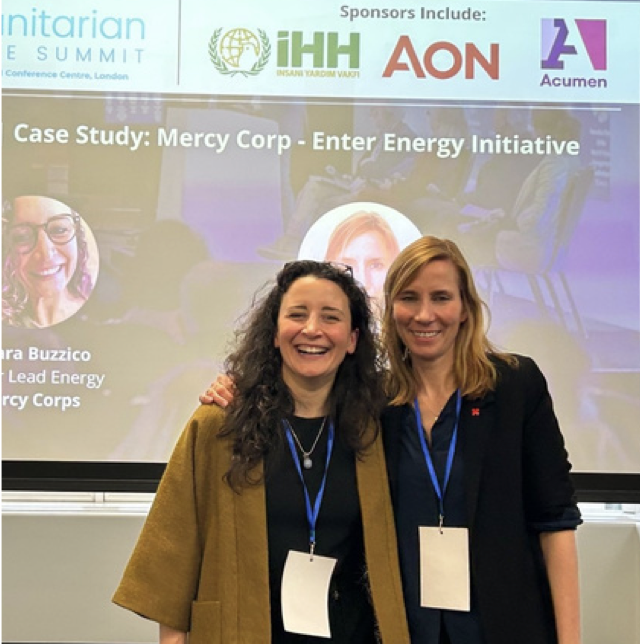
On 26 February 2026, the Humanitarian Finance Summit convened more than 500 senior leaders from around 300 organisations and 39 countries at the Queen Elizabeth II Conference Centre in London. Co-hosted by the Humanitarian Finance Forum and AidEx, the Summit has become a central fixture for senior-level dialogue across the public, private, and philanthropic sectors on the future shape of humanitarian financing.
The message was clear: the current financing architecture is not simply under pressure, it is structurally misaligned with today’s realities. With traditional donor funding projected to decline by up to 38% and needs continuing to grow, the question driving the programme was how to move the tools we already have from pilots into replication and scale.
Facilitating From Diesel to Solar
In the Summit’s case study stream, Anne-Sofie Munk, Director of the HIFHUB, facilitated From Diesel to Solar — Financing
Energy Infrastructure in Refugee Camps, presented by Chiara Buzzico of Mercy Corps.
In Ethiopia, which hosts more than 1.1 million refugees, up to 90% of electricity demand in displacement settings remains unmet, and where available it is typically supplied by diesel at around USD 0.50 per unit. Through a special purpose vehicle, Humanitarian Energy PLC, Mercy Corps and a local Ethiopian energy company have financed and now operate a solar mini-grid in Sheder refugee camp using a blend of grants and equity. It delivers 24/7 electricity at close to half the previous diesel cost, reaching around 17,000 people.
The session’s central insight resonated far beyond the energy sector: the problem in displacement settings is not willingness to pay, but whether capital is designed to build systems meant to last.
Read the Executive Summary and Case Studies Recap.